
Spectral laboratory
How to identify a substance by its spectral lines and unlock new recipes.
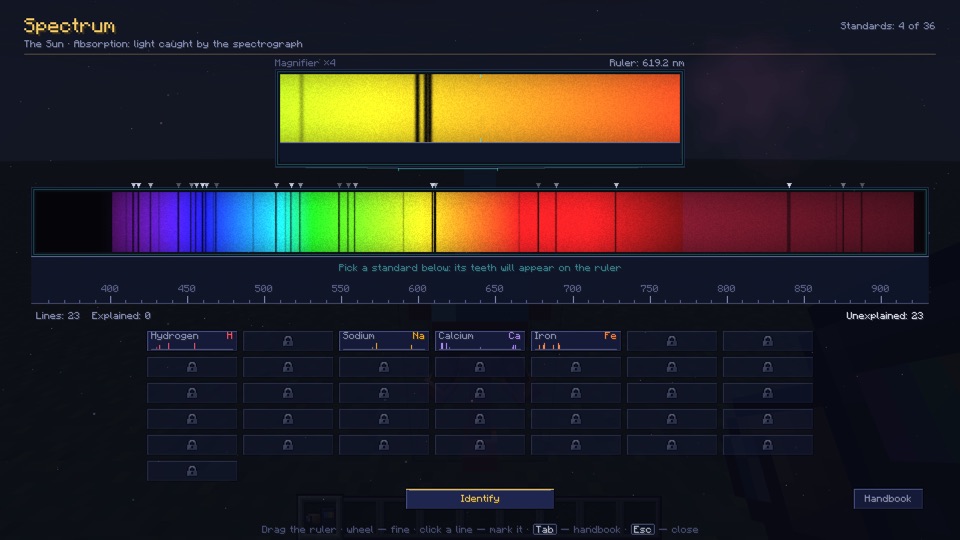
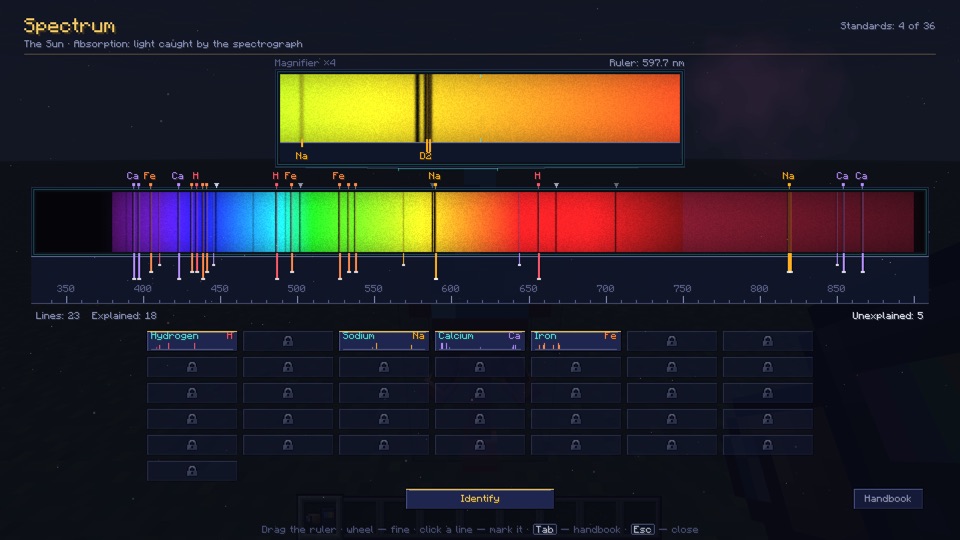
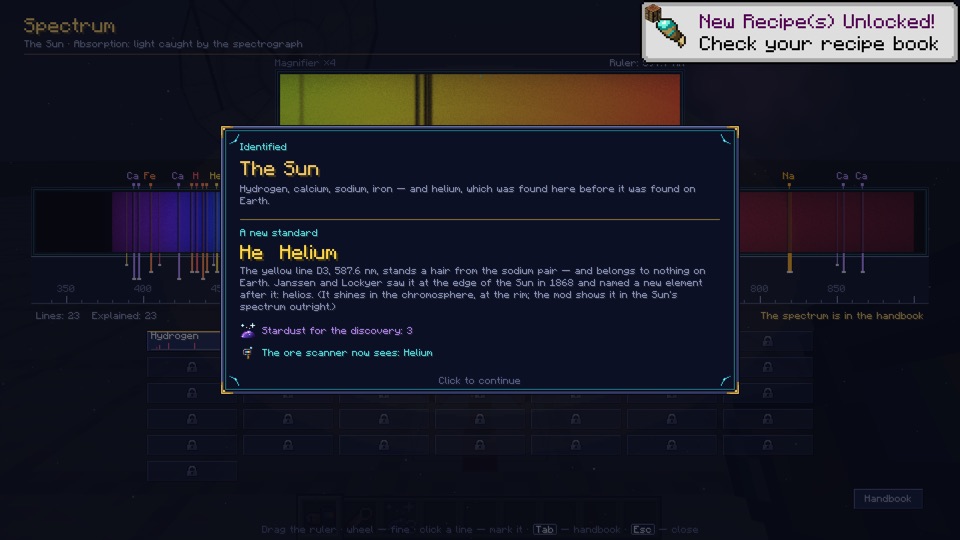
An ore sample, a creature part, a gas or the light of a star give a spectrum. Match its lines with the references — the real lines of substances — and you learn the substance, and with it the recipes made from it.
…
Hands-on
| What to do | How |
|---|---|
| Feed a sample | put it into the laboratory: it burns in the arc, and the prism spreads the light into a spectrum on screen |
| Match a reference | slide the references along the ruler until their lines sit on the peaks of the spectrum |
| Mark the unknown | mark all strong lines of the single unknown substance |
| Check | the laboratory says “matches” or “does not match” — without telling what is wrong |
The lines are real — from the reference tables: hydrogen’s Balmer series, the sodium D lines, calcium H and K, oxygen bands. Where the game takes liberties, the reference text says so. If a sample holds two unknown substances, you need a simpler sample.
On a telescope, the spectrograph shows which bodies have air and life.
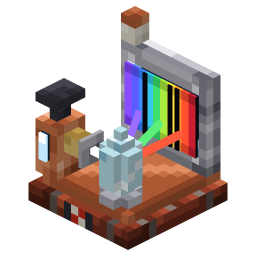 Spectral Laboratory Mk1
What next
- “The telescope and the sky” — the spectrograph is mounted on it.
- “Radio telescope” — the next instrument of the sky.
- “Machines and energy” — the laboratory needs energy.