
The Codex of Currents
The fluxionist's book: chapters and entries, knowledge and study, the Reckoning Desk and the riverbed puzzle, the Fair Copy for a friend.
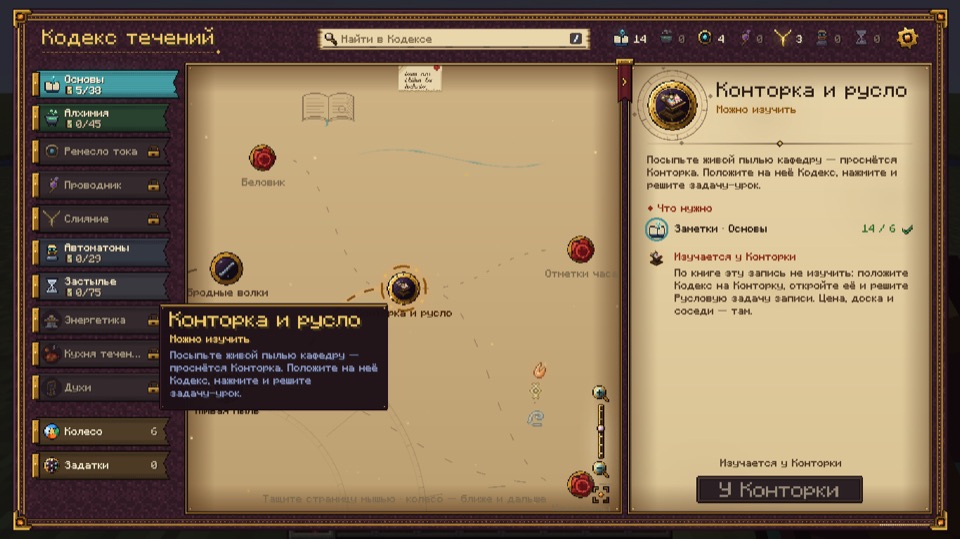
The  Codex of Currents is your own notebook and the main screen of Fluxion: what to build, where to look, what to
beware of and what to study next. A pinch of quickdust on a bookshelf wakes it. Knowledge lives in you, not in the book: a lost
Codex is woken again from another shelf and forgets nothing. All entries by chapter are in the Codex of Currents
reference.

Chapters
| Chapter | What it is about | How it opens |
|---|---|---|
| Basics | the Loupe, currents, the Desk, crystals, metals, the world | from the start |
| Alchemy | the Crucible, distillate, vessels and siphons, potions, guises | the Crucible entry after Quickdust |
| Artifice | the Flux Workbench, devices, gear, Circles, totems | after Fluxsteel from the Crucible |
| The Conduit | the gauntlet, lenses, tracery and the Pantograph | after the Flux Workbench |
| Confluence | the altar, weavings, gear, Inscription | after the Conduit and distillate |
| Automata | worker mechanisms and sigils | after the Flux Workbench and siphons |
| The Stillness | murk and mire, Dissonance, the cults, the worlds, the finale | two warning entries are visible from the start |
The chapters of compatibility branches (Energistics, Kitchen of Currents, Spirits) open when the mod they need is installed. Without it the chapter's tab is dim, with a lock and a red Needs mod line, and its entries cost nothing: they cannot be studied and their puzzles cannot be opened — so you never spend resources on a branch you cannot reach anyway.
Entries and their states
Entries lie on a canvas and are joined by streams: what you study flows into what follows from it. Drag the page with the mouse to walk along the riverbed. A previous entry may stand in another chapter — then Study first names it.
| State | What it means |
|---|---|
| Studied | the entry is open in full |
| Ready to study | the previous ones are studied and you know enough |
| Needs more knowledge | the previous ones are studied, but you know too little yet |
| Sealed | the previous ones are not studied — or a mod it needs is missing |
Under an unstudied entry's title is its lure: what to do to open it. The Codex opens itself on an entry you can study, and once you know enough for a new one, a line above the hotbar says Ready to study.
Knowledge
An entry asks for one or more kinds of knowledge:
- notes of chapters — first readings with the Loupe bring them (The Loupe); studying spends them;
- readings — read a certain thing, block, creature or place with the Loupe, or witness an event (any one from the list will do);
- revealed currents — read a thing that has the current.
When you know enough, press Study: the notes soak into the text, streams in the chapter's color gather to the book, the entry opens, and the next ones surface behind it. Some entries also take a share of Dissonance — the price knowledge takes from the mind (Dissonance and Visions).
тигель in an English game finds the Crucible. It never shows what is sealed or unrevealed. Click a revealed current on the Wheel
page to see which things you have read it flows in, and how much.The riverbed puzzle
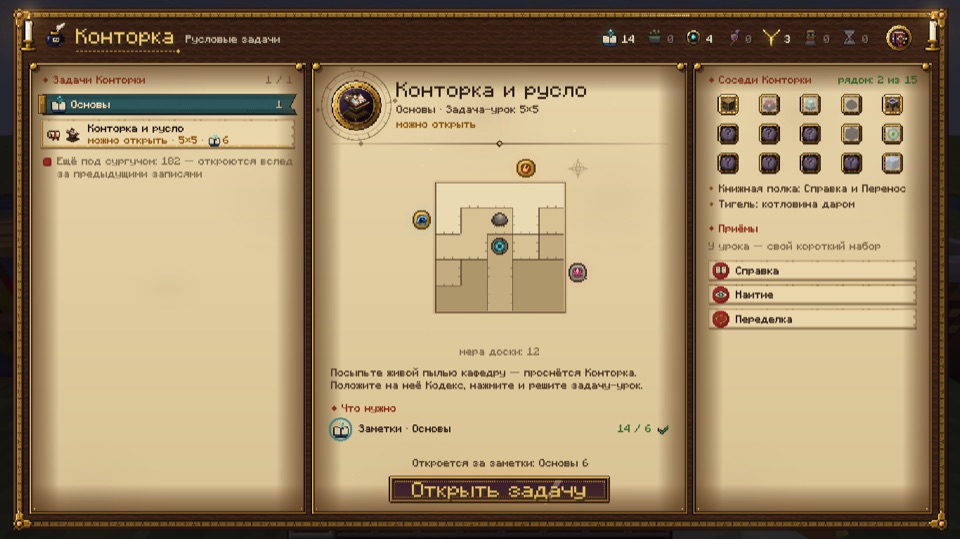
Many entries are studied not with the button but by solving a riverbed puzzle at a 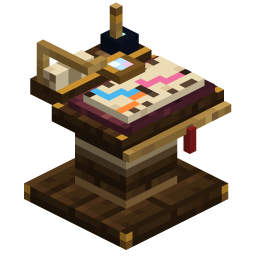 Reckoning Desk. A lectern
sprinkled with quickdust becomes a Reckoning Desk; lay the Codex on it (use the Desk with the Codex in hand) and use it — a window
opens with the puzzles you can open now: price, board size, state. Sneak with an empty hand to take the Codex back.
The puzzle is yours, not the Desk's: two can work at one Desk, each with a board of their own, and an abandoned puzzle waits as it was — at any Desk. Every fluxionist has the same boards, so solutions can be discussed.
How a channel flows
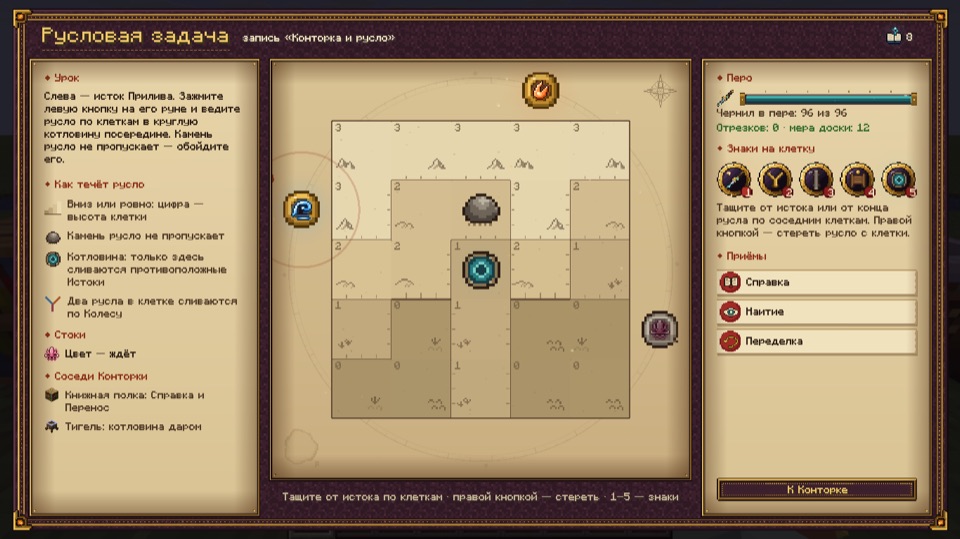
The board is a map of a riverbed. Along the edge are springs (each pours the current of its rune) and outlets (each waits
for its own). Channels are drawn with the  Ruling Pen: drag from a spring across neighboring cells.
- Downhill or level: the number in a cell's corner is its height. A channel does not flow uphill.
- Stone blocks a channel, and a channel that runs into a pit cannot climb out.
- Merging by the Wheel: two channels meeting in a cell merge — Gale and Tide give Drift, Ember and Gale give Spark. No more than two channels meet in one cell.
- A basin: the only place where opposite Springs merge — Tide and Ember give Bloom.
- A Pole sign pulls a current passing through it: Ember through a Lattice sign comes out as Gleam. To a current with no combination with that Pole, the sign is stone. Channels do not merge on a sign.
- An unrevealed current cannot be led: read a thing it flows in with the Loupe.
Marks and ink
| Mark | What it does |
|---|---|
| Fork | the cell gets a second exit: the channel splits in two with the same current |
| Aqueduct | a channel passes across another without merging; only on plain ground, running straight |
| Lock | a channel may enter this cell from a neighbor one height lower |
| Basin | a Crucible by the Desk: one plain cell becomes a basin — for free |
Each mark costs a note of the entry's chapter. A segment of channel takes a division of ink; a full pen holds 96 divisions, and erased ink does not come back. A dry pen is refilled with an ink sac and any current shard.

Techniques and Desk neighbors
Your hand holds techniques: three, plus one for every three milestones studied, up to six; each is played once. The common ones: Hunch (threads from the outlets to the springs), Redo (erases the last three segments and returns their ink), Ponder (one more technique), Leveling (a 3 × 3 square settles to its average height), Set Aside (one outlet may stay unfed, but the riverbed is no longer clean), Trial (a spring changes its current). Neighbors within four steps of the Desk lend their own:
| Neighbor | What it gives |
|---|---|
| a bookshelf | Reference (correct segments penciled in) and Transfer |
| an enchanting table | Table Lore: 5 experience levels become 6 notes of the puzzle's chapter |
| a beacon | Beacon Light: two more techniques |
| a Crucible | a basin for free |
| a Flux Workbench | the first lock for free |
Chapters add techniques of their own: the Conduit — Aim, Keen Eye and the Flux Vow; Hour Marks — the Hour Check (the next lock and aqueduct for free).
The price
- Opening a puzzle costs the entry's notes. The solved puzzle is the study itself.
- A clean riverbed — a solution no longer than the board's measure (the window shows the segment count) and without Set Aside: a third of the price comes back as notes.
- Start Over — the same board on a clean sheet and a new hand for half the price (the lesson has no such button).
- Out of notes — Table Lore at the Desk.
The Fair Copy
The  Fair Copy hands a friend everything your Codex knows, all at once: a friend who joins when you are already near
the Stillness need not start from quickdust. Take a blank fair copy and use it on the Desk holding your Codex: your studied entries
(boards solved), revealed currents and readings are copied in. Your friend takes it in hand and right-clicks — the knowledge becomes
theirs, and the fair copy is blank again.
- Filling a fair copy costs half a pen of ink (48 divisions).
- Notes are not copied; entries written in from someone else's fair copy are not passed on further and give no Insights.
- Entries with Dissonance take half their Dissonance from the reader, no more than 10.
Aptitudes and advancements
Under the chapter ribbons is the Aptitudes tab: growing the fluxionist with Insights that studied entries and first victories bring (Aptitudes). In the game's advancements window (L), Fluxion has its own Fluxionist tab — 45 milestones of the path; the Codex is the path itself, the advancements only reflect it.
What next
- Flux and Murk of the World — where to work.
- Aptitudes — what to spend Insights on.
- Dissonance and Visions — the price of heavy entries.