
Reckoners in the World
Gauge Stones and the Gauge Post, Reckoner Records, coffers and gauge jars, the lock puzzle, the Gauge Ring and the Well.
The Reckoners — the ancient order that first measured the currents of the world — left almost everything worth doing in
the world: Gauge Stones that speed up flux, locks and archives with hoards, Records that bring knowledge
( The Reckoners). Their pale gray stone with bronze and measuring scales can be recognized from afar.
Gauge Stones
A  Gauge Stone is the head of a seven-block pillar: a pale column on a stepped plinth, its head girded with
a bronze band and a scale. The stones stand by old riverbeds, on hills, by rivers — in forests, taiga, savannas, plains and
meadows, in deserts.
- Flux twice as fast. In the 3 × 3 chunks around a stone, flux between chunks flows twice as fast: whatever a workshop has drawn seeps back from the neighbors twice as quickly.
- Channel Record. The Loupe on the stone's head tells what the stone does to the flux, and each fluxionist's first
reading gives a
 Channel Record — one per stone.
- Cast pillar. While the head stands, no pickaxe takes the stone and tile of the pillar under it, and nothing — pickaxe, blast or piston — takes the head itself. Reckoner stone and Marked Tiles are mined in ruins — a fallen stone has no head, and its pillar is not cast.
Attuning
There is a socket in the bronze band: set a Spring shard in it ( Tide,
 Strata,
 Ember or
 Gale) and wake the stone with quickdust. An attuned stone draws flux toward
itself: at rest its chunk holds about 1.35 of its riverbed, the neighboring chunks about 1.15, the ring beyond a little
less than the riverbed. No flux is created — the neighbors give it up — but a workshop by an attuned stone in a dry place
lasts noticeably longer. Another shard in the socket breaks the attunement. Poles do not fit the socket: the stone measures
the currents of the Wheel, and Lattice and Fray are directions.
Gauge Post
A  Gauge Post is a small stone you build yourself from ruin stone and a Marked Tile at the Flux Workbench.
Flux in its chunk flows half again as fast and draws toward the post: the chunk holds about 1.1 of its riverbed. A second
post in the same chunk adds nothing (
 Gauge Stones).


 The Tollkeepers. And on a clear midnight the stones around yours sometimes hold a Roll Call — same place.
Reckoner Records
Records are ready knowledge: a Record read with right-click goes straight into the Codex as notes of its chapters, and
entries are studied with those notes (Reckoner Records).
| Record | Notes | Where to find |
|---|---|---|
| Channel Record | Basics 4, Artifice 2 | the first reading of a Gauge Stone; coffers of wells and archives |
 Tally Tablet | Alchemy 3, Artifice 3 | locks, coffers, the Scriptorium's shelves |
 Woven Record | Confluence 3, The Conduit 3 | the Gauge Ring, archives, the Scriptorium |
 Drive Drawing | Automata 4, Artifice 2 | archives, sealed coffers, the Scriptorium's reading room |
 Opaline Inclusion | The Conduit 3, Basics 2 | 2% from opaline ore without Silk Touch; the vaults of the archive and the Scriptorium |
A  Knotted Cord is the Reckoners' writing in knots: it is not read with right-click but held under the Loupe.
Knotted cords lie in the coffers and barrels of ruins and are sold by the gauger (Villagers).
Coffers and gauge jars
The Reckoners' hoards are not chests but coffers of three grades —  Reckoner Coffer,
 Banded Reckoner Coffer and
 Sealed Reckoner Coffer — and fragile gauge jars.
- A coffer is opened with an empty hand: the lid lifts, the things jump out, and the coffer stays open and empty. Quickdust unseals a closed coffer — a whirl of Springs, and one more thing comes out. A broken closed coffer gives the same; an open one gives nothing. Coffers hold shards, quickdust, regulus, opaline, Records and cord; sealed ones also fluxsteel.
- A gauge jar breaks from a blow or an arrow, like a pot, and spills its contents; with Silk Touch it comes off whole.

The lock: a water puzzle
A Reckoner Lock is set into a river bank: a chamber along the river, its lower end in the river itself, and a keeper's
hut — a storeroom behind a gate and a room above ( Reckoner Locks).
- The storeroom is shut by a
 Sluice Gate: no pickaxe or blast breaks it.
- The water is led by Sluice Valve wheels — bronze handwheels on the chamber wall. Each valve has its own
measure: one lets in several layers of water, another lets them out. A turn with an empty hand brings the water to "what
was plus the measure"; the excess runs over the chamber's edge.
- The gate rises when the water stands exactly at the lit Marked Tile. The mark is neither the top nor the bottom of the chamber, so one valve cannot reach it: you have to alternate the valves.
- The hint is the keeper's note on the lectern.
The same valves hold the Flooded Archive — the Reckoners' great dungeon under a riverbed (Ruins).
The Gauge Ring
Now and then six Gauge Stones stand in a ring around a spring; next to it lies a broken frame of Reckoner stone, a lucent skein hangs over the spring, and the banded coffer and barrel hold a Woven Record, cord and a Lattice shard. The ring's stones stay silent until you have revealed the four Springs and the two Poles: "The ring stays silent". The Codex remembers a ring once read — it is one of the conditions of the Stillness entry, and the broken frame by the spring will matter later (The Stillness).
Searching for a ring blindly takes long: the  Master Gauge Stone in the Flooded Archive's vault gives everyone
who reads it a map to the nearest ring.
The Reckoners' Well
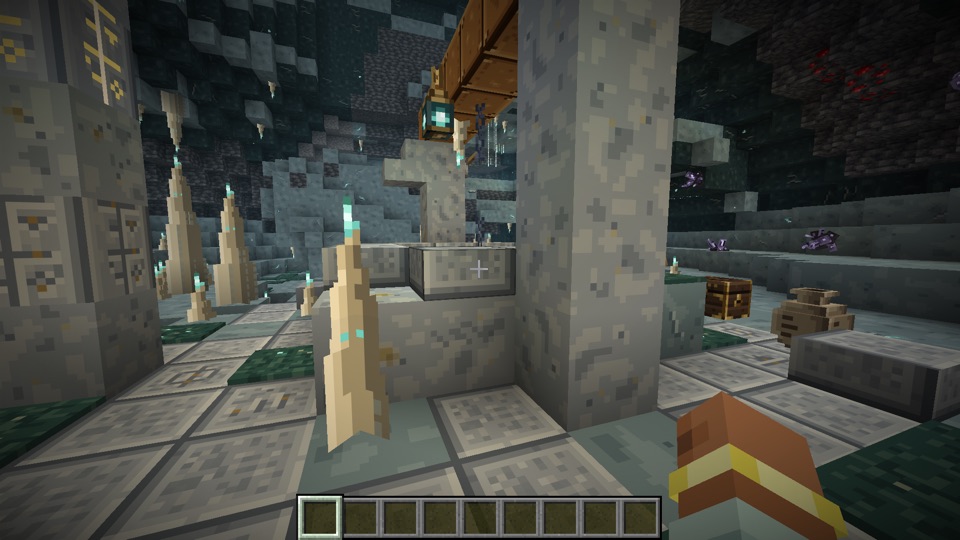
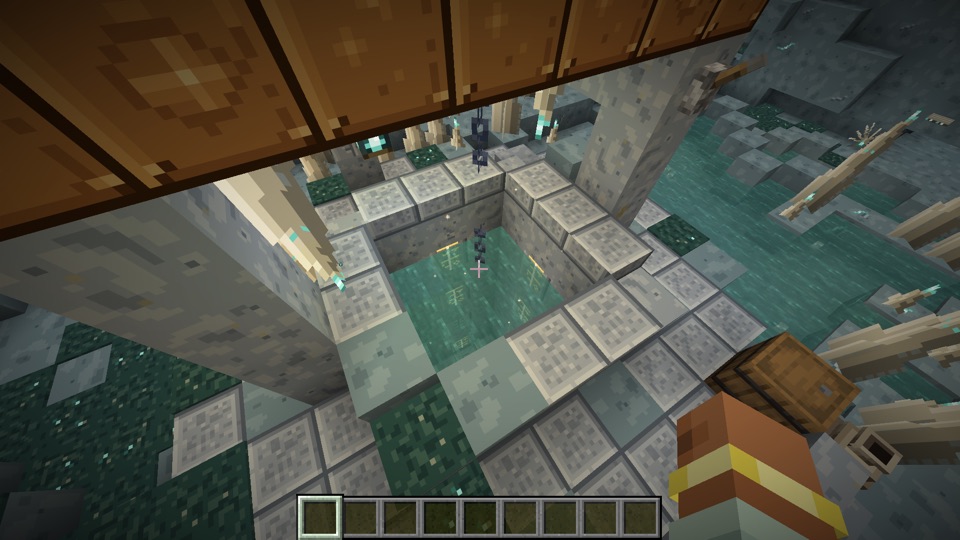
In the Flowstone Grottoes the Reckoners sank wells where the flux comes close to the stone: a platform of tile on the grotto floor, a well frame with gauge tiles down the shaft (the shaft is full of water, a mark glows at the bottom), a windlass with a chain and a Pearl Lamp. On the gauger's table are a coffer and a barrel: paper, cord, a Channel Record, a Tally Tablet, cave pearls, quickdust and shards of the four Springs.
Reckoner Plinth and Column
The Reckoners' masons also cut parts of the Confluence altar. The  Reckoner Plinth works as a Plinth, but the
stream of a side Reckoner Plinth to the Heart is a quarter calmer. The
 Reckoner Column works as a Column;
when all four Columns of the altar are Reckoner ones, the distillate of every Confluence is a tenth cheaper (together
with other discounts — never below two thirds of the price). Both are made at the Flux Workbench from stone and Marked Tiles.
Techniques at the Desk
The Reckoners help with the Riverbed Task too:
- Cross-Check — in the deck of any chapter. Played, it spends any Reckoner Record from your inventory, and the segments of the solution lay themselves down, free, without ink, — up to half its length.
- Read the Marks — comes when a Marked Tile stands within four steps of the Desk: up to four segments of the solution not yet drawn show through in pencil.
What next
- Ruins and dungeons — the Flooded Archive, the Scriptorium, Tollkeeper posts and Sunken shrines.
- Villagers — the gauger and his knotted cord.
- Events — the stones' Roll Call and the Toll Collection.
- The Overworld — what grows and lies where.