
Spellweave and the Pantograph
A spell you draw yourself: the Pantograph, the board by blank tier, marks and channels, fork, merge by the Wheel, clash and curl, actions at the mouth, switches and memory, strike shapes, Target and Latch, Pond and Lockgate, the price, patterns and tracings.
A Lens Grinder lens is a ready action: everything strikes one target at once. A tracery is a spell no node offers: lightning that
leaps between enemies; two strikes at two targets; a blow repeated from a rune in the air; healing for friends and fire for foes in one
lens; every third cast three times stronger. You draw it on a board with springs, channels and mouths, and the
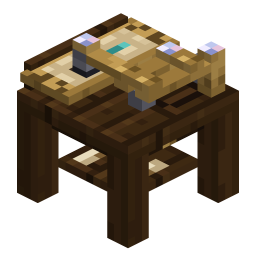 Pantograph cuts the drawing into the opal of a blank. Entry — The Pantograph.
The Pantograph
A cartography table + a pinch of quickdust = a Pantograph. A blank or a tracery lens goes into the clamp (click with it), the window opens with an empty hand, sneaking with an empty hand takes it out. The Pantograph will not take a node lens, nor the Lens Grinder a tracery lens: one blank is either a cut or a tracery.

The board
| Blank | Board | Facets | Strength | Mouths | Action level | Murk |
|---|---|---|---|---|---|---|
 Small Lens Blank | 5×5 | 18 | 3 | 2 | up to II | every 4th cast |
 Lens Blank | 7×7 | 30 | 5 | 3 | up to III | once in 16 |
 Great Lens Blank | 9×9 | 54 | 8 | 4 | up to III | none |
- A mark stands in a cell, one per cell. A channel is a segment between neighboring cells (not diagonal); you drag it with the mouse from the cell it flows from — like the pen of the Riverbed puzzle.
- Stream strength: every Spring is 1; a merge adds strengths, a fork divides them evenly. Strength 1 is action level I, 2 is II, 3 and more is III (no higher than the blank allows).
- Tracery strength is the sum of all strikes of one cast. More than the blank's strength — the tracery will not be cut.
Marks
| Mark | What it does | Facets | Price |
|---|---|---|---|
| Spring | a stream of the shard's current flows from here, strength 1; on a lens blank and a great one — a vial of distillate of any current too | 1 | a current shard (a vial — what it holds) |
| Mouth | the stream leaves as a strike; the mouth's kind is a carrier (Palm, Jet, Droplet, Mist, Pool, Courier Moth, Survey); what the strike does is the current that arrived | carrier + actions | the carrier's shard, as on the Lens Grinder |
| Basin | opposite Springs merge here into their compound instead of clashing | 1 | a Strata shard |
| Lull | the strike comes later — 0.5, 1 or 2 s — from a rune in the air where you cast | 1 | a Tide shard |
| Switch | asks a condition: yes — the stream goes straight, no — sideways | 2 | a Lattice shard |
| Surge | the stream comes out every 2nd, 3rd or 4th cast — that many times stronger | 2 | a Fray shard |
| Scent | the cast marks whoever you look at; mouths behind the Scent fly to them for 30 s | 2 | a Gale shard |
| Cameo | a socket for a cameo — a ready small tracery | the cameo's facets | the cameo's marks — anew |
From the shape of the channels, nodes show on the cells by themselves:
- Fork — two or three channels leave a cell: the stream divides evenly, and the fork's mouths strike different targets (the first where you look, the next ones other targets within 6 blocks).
- Merge — two or three channels enter a cell: currents combine on the Wheel (
 Ember +
 Gale =
 Spark), the same current gathers strength.
- Clash — opposite Springs met outside a basin: the strike hits with both actions at ×1.5 and spreads over 2 blocks, but the cast costs a flux more and clouds.
- Curl — a channel that loops back to its own cell: every curl repeats the strike once more.
What the current does at the mouth
| Current | Action |
|---|---|
| Gale, Ember, Strata, Fray | Gust, Scorch, Crack, Excavate |
| Rime, Bloom, Tempo, Murk, Venom, Shift, Hollow | Chill, Mend, Stall, Offload, Blight, Swap, Washout |
| Tide | Douse — puts out fire, soaks; a doused target is "wet" for six seconds |
| Lattice | Brace — steadiness for friends, a fetter for foes |
| Spark | Arc — lightning into the target and a leap to nearby foes; ×1.5 on the wet |
| Blast | Burst — throws foes back around the point of impact, breaks no blocks |
| Drift | Haul — pulls the target to you |
| fifteen compounds | a deed of their own (entry  Voices of the Mouth): Dazzle (Gleam), Dispel (Balance), Drain (Soul), Beguile (Mind), Uplift (Wing), Entangle (Bind), Rend (Fang), Wilt (Ash), Eclipse (Gloom), Reveal (Sense), Rally (Kin), Hinge (Cog), Beckon (Want), Grace (Halo), Bulwark (Ward) |
| the rest | break into the actions of their nearest ancestors on the Wheel: Alloy — Crack and Scorch |
An action you have not studied is a fault at the mouth: the window names the entry.
Switches and memory
The entry  Switches and Memory: the Switch, Surge and Scent, and a Spring as a vial. A Switch asks at the moment of casting:
- about the target: foe, friend, undead, burning, wet, block, wounded (half health or less), against the stream;
- about you: full flux (half the bed or more), dark, sneaking, hurt.
So one lens holds different spells: life on the undead, fire on the living; Brace for friends, Arc for foes. A board takes up to four Switches and up to four Surges.
The extended board
| Mark | What it does | Entry |
|---|---|---|
| Aqueduct | channels cross each other without merging | The Pantograph |
| Rosary | repeats the strike ×2, ×3, ×4 a quarter second apart | Shape of the Strike |
| Spray | a fan of 3 or 5 rays, or a ring of 8 strikes around you | Shape of the Strike |
| Ridge | three strikes side by side across your gaze, each ×0.55 | Shape of the Strike |
| Range | the carrier a level higher: Jet further, Mist and Pool wider | Shape of the Strike |
| Ricochet | the Jet bounces off a block 1–2 times | Shape of the Strike |
| Pierce | the Jet passes through the target and hits 1–3 more behind it | Shape of the Strike |
| Leap | the action leaps along a chain of targets, a kind one to friends | Shape of the Strike |
| Target | at yourself, the nearest foe, under your feet, behind, the avenger, the most wounded friend |  Target and Latch |
| Latch | the strike waits for an event: when hurt, when you hit, kill, land, when a foe comes near, when you break a block | Target and Latch |
| Pond and Ladle | store strikes for later and spend them in battle |  Pond and Lockgate |
| Lockgate | the stream goes on only if both channels arrived — "and" for switches | Pond and Lockgate |
| Overflow | no more than strength 1 or 2 goes straight, the rest sideways | Pond and Lockgate |
New Switch questions: near, crowd, airborne, armored; night, storm, swimming, falling, sprinting, looking down and up; alternate, chance, pond holds. You can have up to four latched strikes; they wait 15 s on a lens blank and 30 s on a great one.
A cameo (Cameo) is a ready piece of tracery on a small blank: instead of springs it has an Inlet, where the bigger board's
stream enters, and an Outlet, where it leaves. A lens blank has one cameo socket, a great one two; the Pantograph copies the drawing, the
cameo stays with you.
The price
- Tracery facets: a channel is half a facet per segment, marks and mouths their own facets, a curl and a clash two more each. More than the blank's facets — it will not be cut.
- A cast costs facets / 4 flux plus one flux per clash; long channels make an expensive cast. Repeats and delayed strikes do not pay again.
- The cutter drinks chunk flux — facets × 2, a flux every half second — and asks for shards by marks; a missing shard can be replaced by a Snarl Thread. Recutting a lens costs again.
- A tracery costs more than the same strength from the Lens Grinder: it buys precision and invention, not endless damage.
The window
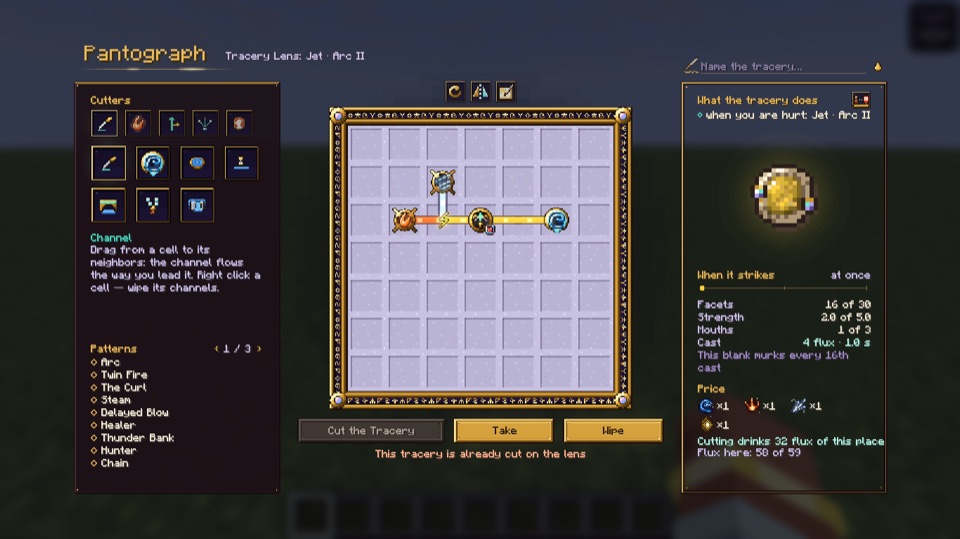
- On the left — cutters in tabs (Channels, Springs, Flow, Strike, Cameo; digits pick cutters, Tab the next tab), below them — the setting seals of the chosen cutter: mouth kind, Lull time, Surge count, Switch condition, Target aims, Latch events.
- Mouse: left button with a mark — place it, with the "Channel" cutter — drag a channel; right button — remove a mark or erase a segment; the wheel over a mark — its setting; Ctrl+Z — undo.
- On the right — the sheet: what the tracery does in plain words, a line per strike; the "When it strikes" bar; facets, strength, cost and cooldown; the price; the "The lens · Trial" switch — a small scene of who is hit and when. A fault is a red cross right on the cell.
- Patterns — where to start: "Arc", "Twin Fire", "The Curl", "Steam", "Delayed Blow", "Healer", "Thunder Bank", "Hunter", "Chain" and more; a click lays the pattern on the board.
- Tracing: "Make a tracing" puts the drawing on a sheet of paper — the tracing shows in the list at any Pantograph, and a friend on the server cuts it at theirs. Above the sheet — the tracery's name (up to 24 characters) and a drop of carving color: gold for free or a dye. Changing only the name or color costs no shards and no carving.
What next
- Nodes, conjunctions and the lens wheel: The Conduit and Lenses.
- The lens blank is grown by Confluence: Confluence.
- Currents and how they combine: the Wheel of Currents.