
Devices and machines
What holds for every device: the land's flux as their energy, the bed floor, the Catchment and Flux Reservoir, siphons instead of wires, the Flux Mill and other mods' energy, hoppers and pipes, windows and the Loupe, block builds, owners and guests.
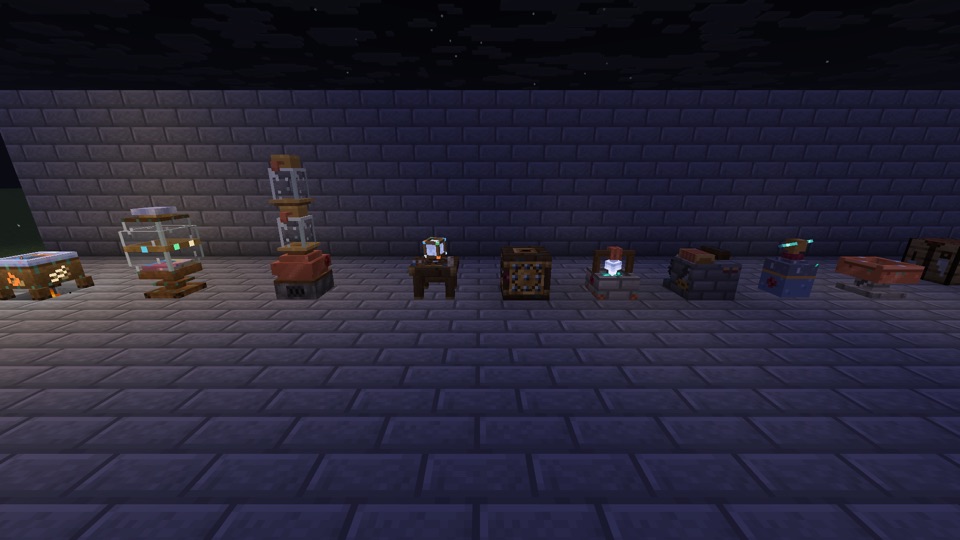
A device is a block of the mod with its own job: the Crucible, vessels and siphons, retorts, the Flux Workbench, the Forge, the Molder, the Confluence altar, the Lens Grinder, totems and mirrors. Here is what is true for all of them at once. All devices by group, with models and Codex entries, are in the Devices reference.
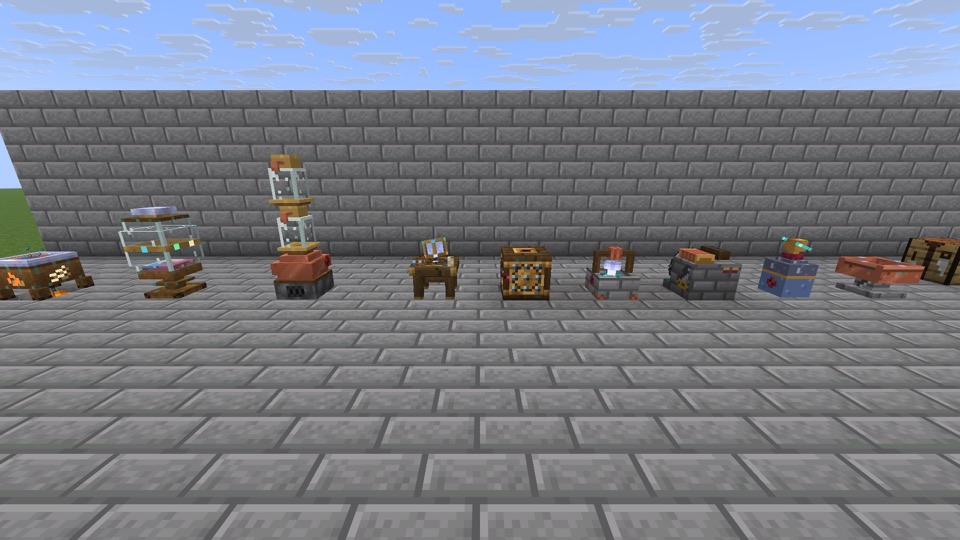
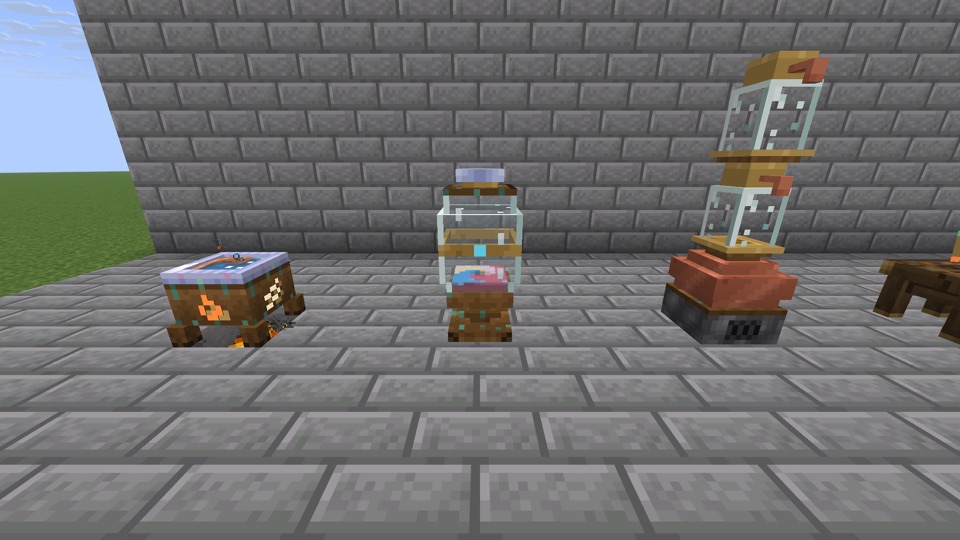
Flux is the devices' energy
The mod has no "energy" of its own in units. Devices draw the flux of the piece of land they stand on: flux flows through chunks by itself, every chunk has its own bed — how much flux the land holds.
- The bed floor is a tenth of the bed: nothing draws below it. On drained land a device waits, and the Loupe and window say why ("The land has nothing to pay", "Dry").
- One unit for the whole mod: chunk flux, flux in a Reservoir and charge in an item are counted as one number.
- A
 Catchment next to a Flux Workbench lets crafting draw from the nine chunks around, each by how full it is:
the area dries evenly.
- A
 Flux Reservoir stores the top of the flux while the land is full (above 0.9 of the bed) and gives it back
in a drought (below 0.6); it holds 240. A broken jar returns its store to the land.
- A
 Charging Basin charges items with the land's flux.
- A living Snarl nearby (within 8 blocks of its seam) carries off up to a quarter more with every draw, and the Flux Workbench, Crucible and Conduit misfire now and then.
Set up the workshop by a river and willows, spread the hungry devices over different chunks. What the bed and murk are — the Flux and Murk of the World guide.
No wires
Flux is not carried by wires — it flows through the land by itself. Between devices flows distillate: siphons carry it downhill from vessel to vessel, from the Crucible to a Gyre (the Vessels, Siphons and Distilling guide). The Conduit is a fluxionist's bracer, not a cable.
- Distillate is not a fluid: other mods' pipes and tanks don't carry it. Only the Energistics branch puts it into an ME network.
- Items — by the game's slots: hoppers and other mods' pipes put into devices and take from them, as with a chest. On the Brewing Tower the sides and top take catalysts, the bottom gives the brew; the Molder takes from the storage above it. Current holders hold no items.
- Through-Mirrors carry items far, a Stand-in gives you a block's face from a distance.
Other mods' energy
The 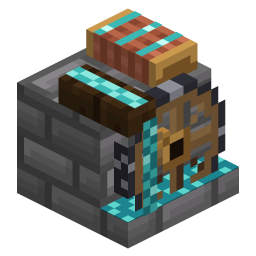 Flux Mill turns the land's flux into energy for other mods' machines: one flux is 800 units of energy
(FE, one to one across mods). Its store is 8,000; while it isn't full, the mill takes 0.5 flux from the land every half second
and pushes energy to its neighbors on all six sides, at most 400 per step. No consumer — the store stays full, no flux is spent.
The wheel turns while energy goes out.
- NeoForge — the loader's own energy; Fabric — Team Reborn Energy (machine mods bring it; without it the mill stands).
- The mod's devices can't accept other mods' energy: their energy is the flux of the place.



Windows, the Loupe and Spectacles
- A window only where it can't be done without one: the Flux Workbench, Lens Grinder, Pantograph, Reckoning Desk, Biome Converter. Other devices take items by a press or a throw (the Crucible catches thrown items), and their state shows on the model.
- The
 Loupe in hand reads a device instead of opening it: what the Crucible and a vessel hold, whether a siphon
runs, what's missing. With an empty hand the window opens as usual.
 Diviner's Spectacles on your head show what current-holding devices hold when you look at them — hands free.
- A fault shows without a window: a siphon with "no receiver", a mill with a dry flume, a totem with a dark rune. A window tells a newcomer why a device stands still instead of "0 of 0".
- With Jade, the probe shows the distillate, heat, murk and currents of the block under the crosshair.
Tiers and builds
- A device has no versions. A tier is another device (the Fluxsteel Retort after the Retort) or an upgrade next to it: Bands on a vessel, a Gale Fan at the Forge, an Abacus at the Brewing Tower, a Catchment at the Workbench. Each has its own price and fits only its own device.
- A device of several blocks is placed as one item (the Gyre, the Brewing Tower — two halves, a broken one drops one item) or wakes up from quickdust: the Flux Forge, the Slipway, the Brewing Tower, the Converter tower. Structures like the Confluence altar have a plan: the Codex draws it and places a ghost.
- The owner is whoever placed it. Another player's paired device (mirrors, Ferrystone, Through-Circle, totems) works for you only if its owner opened it to guests. A server operator counts as the owner.
What next
- The Crucible — a fluxionist's first device.
- The Flux Workbench and Artifice Devices — crafting for the land's flux, the Forge, the Molder, the Mill.
- Current Circles, Totems, Through-Mirrors — workshop devices.
- Biome Converter — a device that grows a place.