
The Crucible
The heart of alchemy: how to wake the Crucible, which heat dissolves what, the rules of distillate, the catalyst and the first recipes — fluxsteel, tonics, orbs, glints and crystal seeds.
The 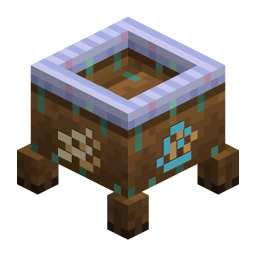 Crucible dissolves things into currents and brews new things out of them: fluxsteel for devices, wax for
vessels, opaline, quickdust, tonics, light without a candle, and glints. It is the fluxionist's first big workshop — the Codex
chapter Alchemy begins with it.
How to get it
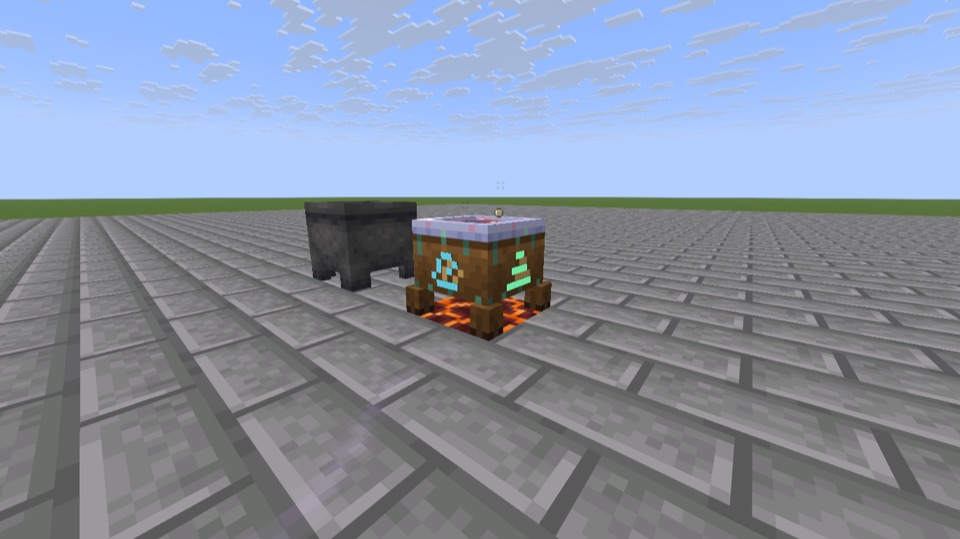
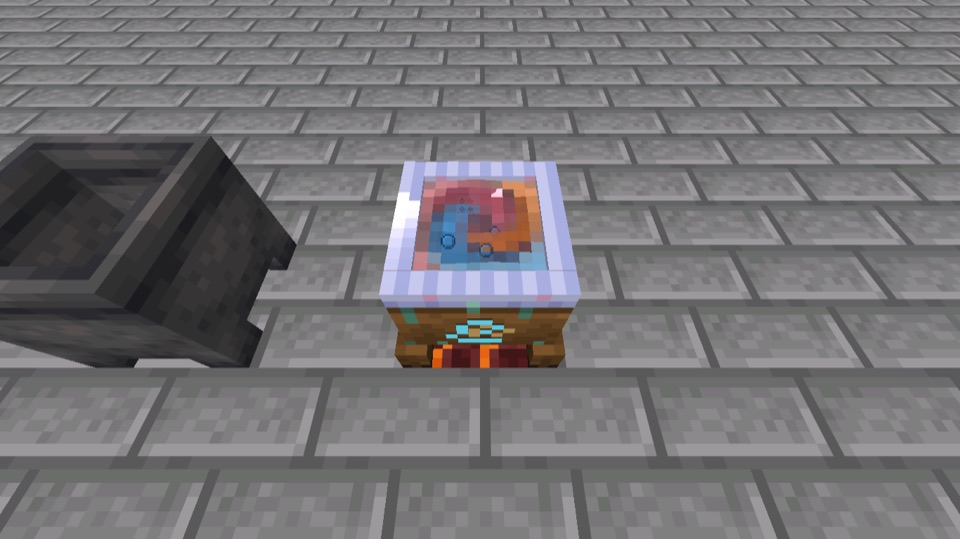
The Crucible is not forged or crafted — it is woken. A pinch of  Quickdust on a plain cauldron (empty or
filled): a whirl of the four Springs, a ring of Tide, and the cauldron turns to bronze, its feet become paws, opaline shows
along the rim. Waking needs no knowledge, but the Crucible's recipes are opened by Codex entries, starting with
The Crucible.
Water and heat
- Water by the bucket. A full Crucible is one bucket — that is its whole measure. You can scoop the bucket back, but then whatever is dissolved splashes out as murk into the land around; a broken Crucible spills it the same way.
- Heat comes from the block below. Without heat the Crucible is just a bowl: what you throw in lies on the bottom.
- Gentle heat — a campfire, fire, magma, a lit furnace, an
 Ember Orb. It dissolves soft things: herbs,
flesh, coal, dust, wax.
- Strong heat — lava or a lava cauldron. It dissolves everything that has currents.
- Gentle heat — a campfire, fire, magma, a lit furnace, an
- Solid things are those where
 Strata,
 Alloy and
 Prism make up half
of the currents or more: metals, stone, glass, gems. In gentle heat they do not sink — they float up and fly over the rim.
That way iron is not lost in a Crucible over a campfire.
- A thing without currents never sinks, whatever the heat.
- Water boils away: a bucket lasts 16 minutes of gentle heat and 8 of strong; every dissolved thing drinks more, and brewing a recipe more still. Boiled dry, the distillate scorches and all of it goes to murk.
Ember Orb heats it with no fire at all —
only a thin vapor rises over the bowl. Handy when the Crucible stands indoors.Distillate
Dissolved currents become distillate — a current in liquid form. It is tinted by the mix of its currents, and strands
of the fullest ones spiral across it. The  Loupe and the
 Diviner's Spectacles show what is
inside — a "Distillate" line, runes and numbers; the Spectacles show it without the Loupe in your hand.
- Neighbors on the Wheel get along:
 Tide with Strata, Strata with
 Ember, Ember with
 Gale, Gale with Tide
enter the distillate whole. Compound currents mix with anything without loss.
- Opposite Springs clash: Tide and Ember, Strata and Gale.
A Spring thrown in with its opposite enters only by half, and the other half goes to murk. Whoever went in first stays whole:
the order of throws is part of the craft.
- The limit is 64 parts. Beyond it the Crucible boils over: the excess boils off as murk from the fullest current until the distillate evens out. Vapor and dark flakes over the rim show at any "Mod Graphics" level — that is the sign to stop.
- Every lost part is half a part of murk in the Crucible's chunk. On murk and mire — the entry
 Murk and Mire.
- The Patience aptitude lowers the thrower's loss to clashes and the murk of their things at the Crucible.
To drain the distillate without losing the water, sneak and use an empty hand on the Crucible: the currents go as murk into the land (half a part per part), the water stays. An empty Crucible does not answer. A comparator by the Crucible tells how full it is.
Recipes: the catalyst
A Crucible recipe is a catalyst (the thing thrown in last) and the currents that must be in the distillate at that moment, plus heat. If it matches, the recipe's currents leave, the catalyst too, and the result floats up and flies over the rim (falling back in, it will not dissolve). If not, the catalyst dissolves like any other thing.
When several recipes fit one brew, it is always the same one that brews: the most demanding (most currents); among equals — the one whose currents fill more of the brew; then the one whose leading current comes first on the Wheel (Tide, Strata, Ember, Gale, Lattice, Fray and on in order of composition). So an extra current changes the result — watch the distillate with the Loupe and drain what is extra.
You can throw things from a couple of steps away: the Crucible catches whatever lands on its top. A recipe brews only for the one who has studied its entry — the owner of the thrown thing.
First recipes
| What | Catalyst | Currents | Heat | Entry |
|---|---|---|---|---|
 Fluxsteel Ingot | iron ingot | Strata 6, Ember 4, Lattice 2 | strong | Fluxsteel |
 Bloom Tonic | glass bottle | Bloom 4, Tide 2 | gentle | Hearth Brewing |
 Bindwax ×2 | honeycomb | Bind 3, Root 2 | any | Bindwax |
 Opaline | quartz | Prism 4, Gleam 2 | strong | Opaline from Quartz |
| Quickdust ×3 | redstone | Tide 2, Strata 2, Ember 2, Gale 2 | any | Quickdust from the Crucible |
 Brazier Briquette | coal | Ember 4, Spark 2 | any | 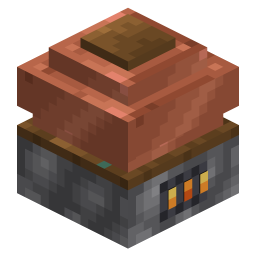 Distillation |
 Brimming Jug | flower pot | Tide 4, Halo 2 | any | The Brimming Jug |
 2
- Fluxsteel is the metal of every flux device: the Conduit, the Confluence Heart, retorts, bands, tools and armor. Strata is in stone, Ember in coal, Lattice in diorite and quartz. Iron melts only over lava; the ingot goes in last.
- Bloom Tonic closes wounds for twelve seconds. Bloom is in bread, apples and eggs, Tide in water and kelp. In a strong boil the tonic curdles and the bottle dissolves.
- Quickdust from the Crucible needs no shards, but the four Springs are two pairs of opposites: start with neighbors (Tide and Strata), and throw in twice the Ember and Gale — half of them goes to murk. That is the price, and better to know it in advance.
Reforming
The Crucible turns plain raw materials into others you would otherwise have to go and find (the entry  Reforming):
sand into clay (Tide 3, gentle), white wool into string (Bind 1, Fang 1), string into cobweb (Bind 3), an empty bucket into a
lava bucket (Ember 8, Strata 2, strong — a Crucible over lava makes the lava for the next one), and sea reforming gives
prismarine, a sea lantern and a sponge without an ocean monument. There is doubling too: gunpowder, slime, glowstone dust and an
ink sac in a distillate of their own currents come out twice.
Orbs
An orb is hanging light with no candle and no support: it goes in the air, on a wall, under a ceiling and into water, shines at full strength, and you walk through it. There are six — one per Spring and Pole. Gather 4 parts of the orb's current and 1 part of Gleam and throw glowstone dust last — two orbs come out. The dust gives the Gleam itself: the first pinch dissolves and leaves it in the distillate. Heat — gentle only (in a strong boil the dust doubles), and if there is Halo in the brew, the dust gives birth to a glint instead.
 1
- Two orbs in one brew — the one whose current is fuller is born; if equal, the first in the row Tide, Strata, Ember, Gale, Lattice, Fray.
- An Ember Orb under the Crucible is gentle heat without fire or smoke, for as long as you like.
- Any orb brands an empty vessel: it goes into the tag and burns in the rune of its current (in detail — Vessels, Siphons and Distilling).
Entry — Orbs.
Glints
A glint is living light and a store of  Halo in a bottle. It is never born in the world by itself — the Crucible
kindles it: Halo 3 and at least three parts of any other current, glowstone dust last, gentle heat. The glint is tinted by
the strongest current of the distillate other than Halo (three Tide shards give a Tide glint). Halo is carried by current shards
and crystals, quickdust, and lumenash logs.

- A glint circles its Crucible for a few minutes and goes out; there are never more than three at one Crucible — while three circle, the dust does not sink.
- Catching: a glint is shy — creep up sneaking with an empty bottle. A
 Bottled Glint lives as long as you like.
- Using the bottle on a block lets the glint out — it circles that place forever. On the Flux Workbench a glint replaces the prism and glowstone dust of a firefly lantern.
Entry — Glints.
Crystal seeds
A seed is your own shard farm. Gather Bloom 2 and 2 of the shard's current and throw the shard last (any heat) — out comes a seed of its current; a dissolved shard of the same current gives 4 parts by itself — enough for two. Only the six primal currents have seeds.
 2
Plant it on any solid face, like an amethyst bud. It grows in three stages and becomes a crystal of its current; each stage takes
a little flux from the land around (the whole growth is 12 flux, a stage about 6 minutes on average), and in drained land the seed
waits. A broken crystal gives shards and half of the flux it drank: seeds make no flux, and a big farm needs living land — by a
river, not in a desert. A broken bud gives the seed back whole. Entry —  Crystal Seeds.
What else the Crucible brews
- Game potions, unheard-of potions and guise tinctures — Potion Brewing.
- Current seeds from Root and wheat seeds — the entry
 Current Pods.
- Caustic and Seeding Brine, Veil Varnish — the entries
 Caustic Brine,
 Seeding Brine,
 Veil Varnish.
- Every Crucible recipe — in the reference Crucible.
What next
- Distillate can be stored and carried: Vessels, Siphons and Distilling.
- Potions from currents: Potion Brewing.
- Fluxsteel is what craft needs: The Flux Workbench.